
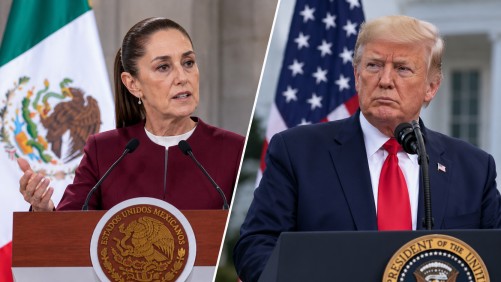
The ongoing debate over drug trafficking and organized crime between Mexico and the United States took a new turn as Mexican President Claudia Sheinbaum responded to criticisms from U.S. President Donald Trump. Sheinbaum defended her administration’s efforts to tackle these issues, while calling for the U.S. to examine its own role in the cross-border crisis.
In a recent press conference, Sheinbaum asserted that Mexico is well aware of its challenges related to drug trafficking, corruption, and organized crime, and is actively working to address them. She emphasized that Mexico should not be judged from outside and pointed out that her government is accountable for its actions. Moreover, she called attention to the need for the U.S. to take responsibility for its contributions to the problem, particularly in terms of drug consumption, money laundering, and the illegal arms trade.
Sheinbaum questioned the measures the U.S. has implemented to tackle issues such as the prosecution of drug traffickers operating across the border, the prevention of money laundering, and the control of illegal arms flows into Mexico. She highlighted the need for more robust efforts to curb opioid consumption and addiction within the United States, asserting that the drug crisis involves responsibilities on both sides of the border. She underscored how the illegal flow of firearms from the U.S. empowers criminal organizations in Mexico.
President Trump’s administration has urged Mexico to intensify its crackdown on officials allegedly connected to drug cartels and organized crime, citing the need for more rigorous action against corruption. Despite this, Sheinbaum highlighted her government’s record of prosecuting officials linked to criminal organizations when evidence is available, regardless of political affiliation. She noted the successes of Operation Swarm, a security initiative aimed at dismantling criminal and corruption networks.
In her concluding remarks, Sheinbaum called for greater transparency regarding U.S. efforts to address fentanyl trafficking and domestic drug consumption. She advocated for a collaborative approach, where both countries critically assess their respective roles and responsibilities in mitigating the cross-border drug crisis.